Updated Physical Activity Guidelines are in!
For the first time in 17 years, the American College of Sports Medicine (ACSM) presented updated resistance training guidelines. Fortunately, these updated recommendations keep things refreshingly simple: move more, sit less, and do a mix of cardio and strength training each week.
For most adults, that means aiming for 150–300 minutes of moderate intensity activity or 75–150 minutes of vigorous intensity activity, plus strength training at least twice per week - targeting all major muscle groups.
Moderate Intensity (you can talk, but not sing) - 150-300 minutes/week
Brisk walking
Cycling on flat ground
Elliptical training
Hiking on moderate terrain
Swimming (steady pace)
Light jogging
Rowing at an easy/moderate pace
Recreational sports (tennis doubles, pickleball)
Dancing / group fitness classes
Vigorous Intensity (you can say a few words, not full sentences) - 75-150 minutes/week
Running or sprint intervals
Cycling hills or fast-paced spin classes
Swimming laps (hard effort)
Rowing (moderate to hard pace)
Jump rope
High-intensity interval training (HIIT)
Sports like basketball, soccer, or singles tennis
Resistance Training Examples (2+ Days/Week)
Lower Body
Squats (bodyweight, goblet, barbell)
Deadlifts (traditional, Romanian, trap bar)
Lunges (forward, reverse, walking)
Step-ups
Hip thrusts / glute bridges
Upper Body – Push
Push-ups
Bench press (barbell or dumbbell)
Overhead press
Dips
Upper Body – Pull
Pull-ups or assisted pull-ups
Lat pulldowns
Rows (dumbbell, barbell, cable)
Face pulls
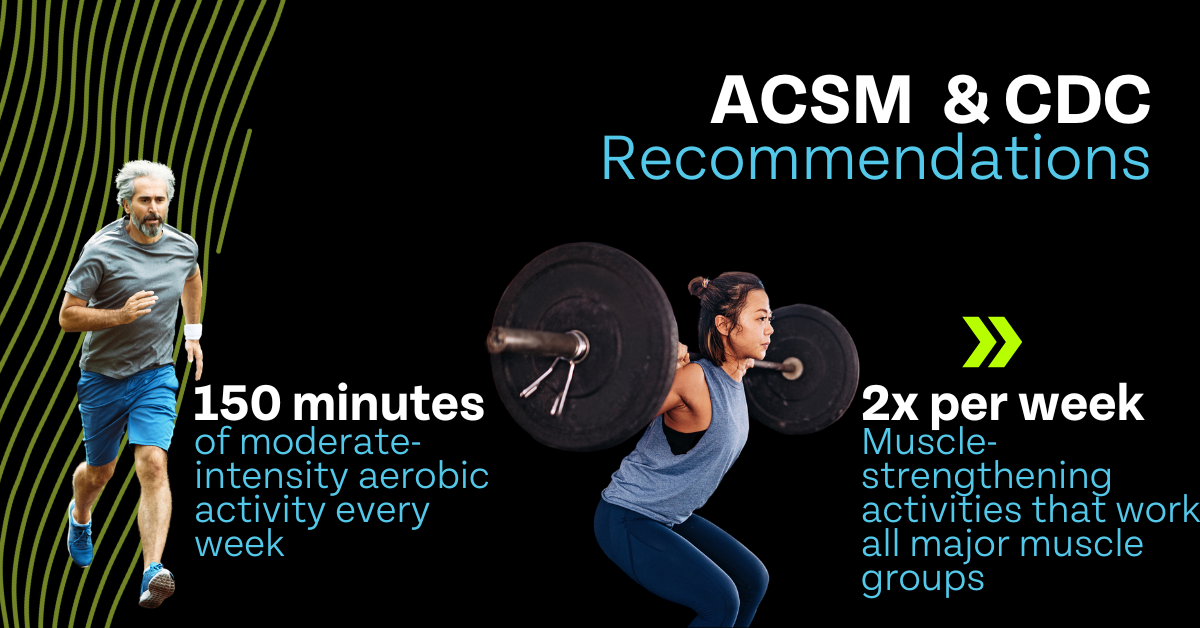
American College of Sports Medicine - acsm.org
The specific recommendations didn’t change a ton from the previous version, the real shift from the updated version is this: it’s not about being perfect - it’s about being consistent.
This means that the ACSM experts leaned heavily into flexibility and personalization, recognizing that your routine should fit your life (not the other way around). Whether it’s structured workouts, weekend sports, or quick “exercise snacks” during the day, it all counts.
So the big takeaway is that you don’t need a perfect plan - you need a repeatable one. Start where you are, build gradually, and if you can sprinkle in some higher-intensity work and strength training along the way, even better.
For those who want to read more from the ACSM, check out their Resource Library