
If you've spent any time on fitness or postpartum Instagram, you've heard someone tell you that your flared ribs are the reason your back hurts, your core "isn't working," or your posture is wrecked. Cue the tutorials on "stacking your ribs over your pelvis" and the endless breathing drills aimed at fixing your rib position.
Here's the problem: the research doesn't back this up. Rib flare is a real, visible thing. It is not a reliable predictor of pain, and there is no good evidence that correcting it fixes anything. As a sports chiropractor who spends most of my week with athletes and pregnant and postpartum people, I am not worried about your rib flare, and I'd like to walk you through why.
What Is Rib Flare?
Let's start with what people are actually pointing at when they say "rib flare." Usually it's the lower ribs sitting more forward and outward than someone's idea of ideal. Clinically that gets measured with the infrasternal angle, the angle formed where your lower ribs meet at your sternum. Sometimes it's just eyeballed, which is its own problem.
You can measure that angle reliably. A 2015 study by Kim and Weon confirmed that two clinicians looking at the same ribs will generally land on the same number. (https://doi.org/10.18857/jkpt.2015.27.3.154) What that study did not do is establish a normal range, or find any link between the angle and pain, dysfunction, or injury risk. Reliable and meaningful are not the same thing, and nobody has closed that gap.
Here's why the ribs sit where they sit in the first place. Rib position isn't some standalone imbalance you develop from bad habits, it's mechanically tied to what your thoracic spine is doing. Diane Lee's 2015 review of thoracic biomechanics showed that rib motion is directly coupled to thoracic extension. Extend through your upper back and your lower ribs flare. That's not a flaw, that's just the joints doing their job. (https://doi.org/10.1179/2042618615Y.0000000008)
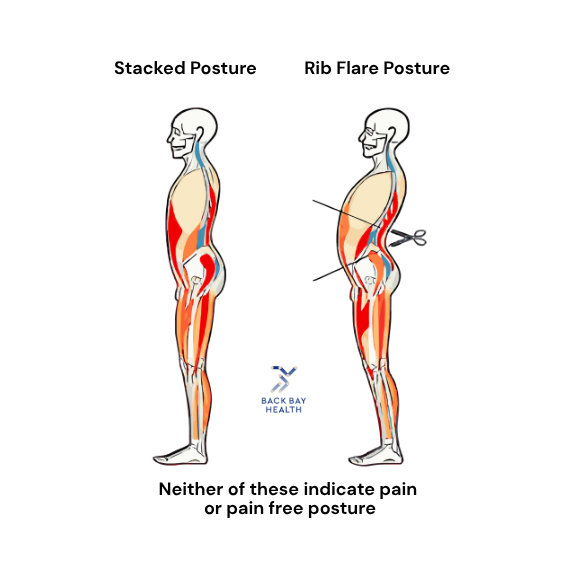
Stacked posture vs rib flare posture.
Rib Flare During Pregnancy and Postpartum
This is also exactly why rib flare shows up so often in pregnant and postpartum patients. Pregnancy pushes the rib cage into sustained expansion to make room for a growing uterus, and a recent study on postpartum mothers found that inter-recti distance, aka diastasis recti, and thoracic expansion track together. (https://doi.org/10.18311/jeoh/2026/54589) That's a mechanical relationship, not proof that one is causing pain or that fixing rib position fixes the other. (If you're navigating postpartum core or pelvic floor recovery, rib position is one small piece of a much bigger picture, not the starting point.)
Does Rib Flare Actually Cause Pain?
Zoom out and this fits a pattern we see constantly in musculoskeletal research: postural measurements that look like they should matter keep failing to matter once anyone actually tests them. A 2008 review by Christensen and Hartvigsen looked at sagittal spinal curves and found no consistent association with pain. (https://pubmed.ncbi.nlm.nih.gov/19028253/) A 2014 meta-analysis by Laird et al pooled multiple studies and found essentially no difference in lumbar lordosis between people with back pain and people without it. (https://pubmed.ncbi.nlm.nih.gov/25012528/) If lumbar lordosis, the most studied postural variable in the entire spine, doesn't separate people with pain from people without it, rib position was never going to be the exception.
Can You (or Should You) Fix Rib Flare?
So what's the evidence that fixing rib flare actually helps? One case report. A 22 year old volleyball player with rotator cuff tendinopathy was treated with a program targeting, among other things, her rib position, and she got better. Worth noting: the report never re-measured her rib flare, so we don't actually know if her ribs changed at all, just that her symptoms did. One patient, no control group, and no measurement of the thing that supposedly caused the problem. (https://www.ncbi.nlm.nih.gov/pmc/articles/PMC7575158/) That's the entire foundation for a lot of rib-focused corrective exercise programming.
None of this means rib position is meaningless in every context. If a specific loaded pattern, like bracing under a barbell, or a specific task, like a full exhale, is limited or provoking symptoms, that's worth training directly. Not because your ribs are in the "wrong" place, but because rotation, exhale control, or tolerance under load is what's actually missing. Treat that. Skip the ribs. If back pain is part of the picture, the same rule applies: chase the limitation, not the posture.
If you have rib flare and no pain, there's nothing here for you to fix. If you have pain, chase the actual limitation instead of the shape of your rib cage. Your body adapts to demand at any rib angle, and the things that reliably move the needle on pain, staying active, building tolerance gradually, sleep, stress, and consistency, don't care what your ribs look like at rest.
Rib Flare FAQ
Does rib flare cause pain?
Not on its own. There's no good evidence linking rib position to pain, and the broader research on postural measurements and pain keeps landing on the same answer, no reliable connection.
Is rib flare bad, or does it mean something is wrong?
No. Rib flare is a normal variation tied to how your thoracic spine moves and, for a lot of women, to pregnancy. It's not a red flag by itself.
Will rib flare go away after pregnancy?
Sometimes it changes on its own as your body recovers, but there's no guarantee, and there's no evidence you need it to change for your core or back to function well. It's one visible part of a much bigger postpartum recovery picture.
Can you fix rib flare?
You can change how it looks with certain breathing and positional drills, but there's essentially no research showing that changing rib position improves pain or function. If you're chasing a specific outcome, like better rotation or a stronger exhale, train that directly instead.
Should I see someone about my rib flare?
Only if it comes with an actual limitation, pain, breathing restriction, reduced rotation, trouble bracing under load, that's worth getting assessed. Rib flare by itself, with no symptoms, isn't a reason to seek treatment.
If you want help sorting out what's actually driving your pain, breathing mechanics, or postpartum core and pelvic floor recovery, reach out to Back Bay Health for a free 20 minute discovery call.
(Psst… this goes for the "ribs tucked" crowd too. Same rules apply in both directions.)
